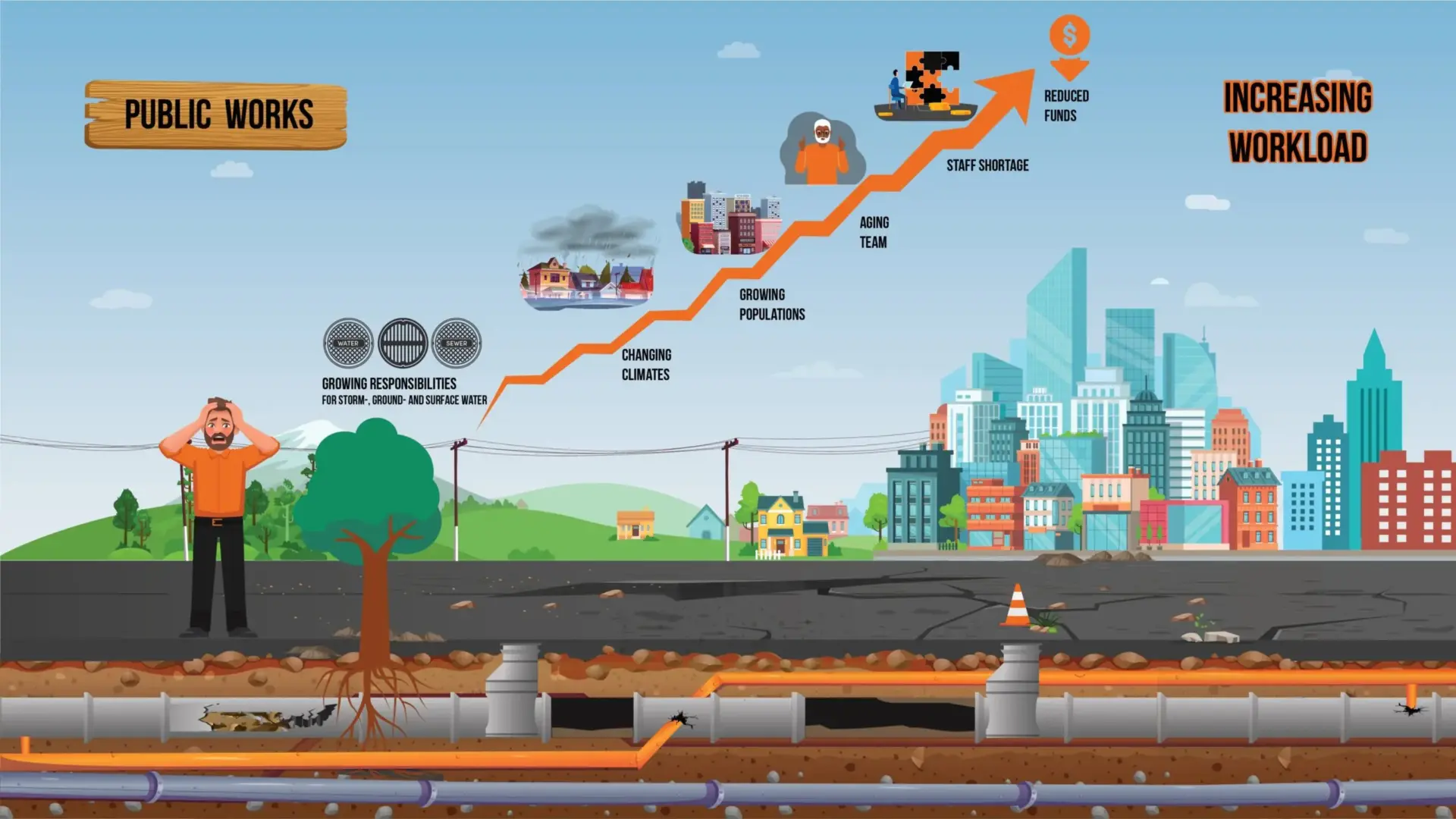
Aging sewer networks. Growing demands. Limited resources. How can municipalities and contractors keep up with maintenance needs while leaving enough time and budget to address the problems they find?
Municipalities and contractors face growing sewer asset management challenges. Responsibilities for stormwater, groundwater and surface water are expanding, while extreme weather and population growth put additional pressure on existing networks.
At the same time, experienced employees are approaching retirement, recruitment is difficult, and funding is under pressure. Teams must maintain more infrastructure with fewer resources, making it harder to keep up with routine work and address problems before they escalate.
Managing stormwater,
groundwater, and surface
water is becoming more
complex and regulated.
Heavier rainfall, droughts,
and flooding put increasing
stress on infrastructure
systems.
Higher demand and capacity
pressure on roads, utilities,
and water networks.
Experienced staff are
approaching retirement,
risking loss of critical
knowledge.
Recruitment and retention
challenges limit operational
capacity.
Budgets decline while
maintenance needs continue
to rise.
Pipes show cracks and
fractures, increasing the risk
of collapse and leaks.
Tree roots penetrate the pipe
joints, blocking flow and
damaging the structure.
Water leaks in and out of the
pipe, causing soil erosion and
loss of capacity.
Pipe sections are shifted or
displaced, disrupting proper
flow.
Debris and sediment reduce
flow capacity and increase
maintenance needs.
Pipes are old and
deteriorating, no longer
meeting today’s performance
demands.
“Too many assets.
Not enough time, staff, or
budget.”
Hover your mouse over the photo to discover!
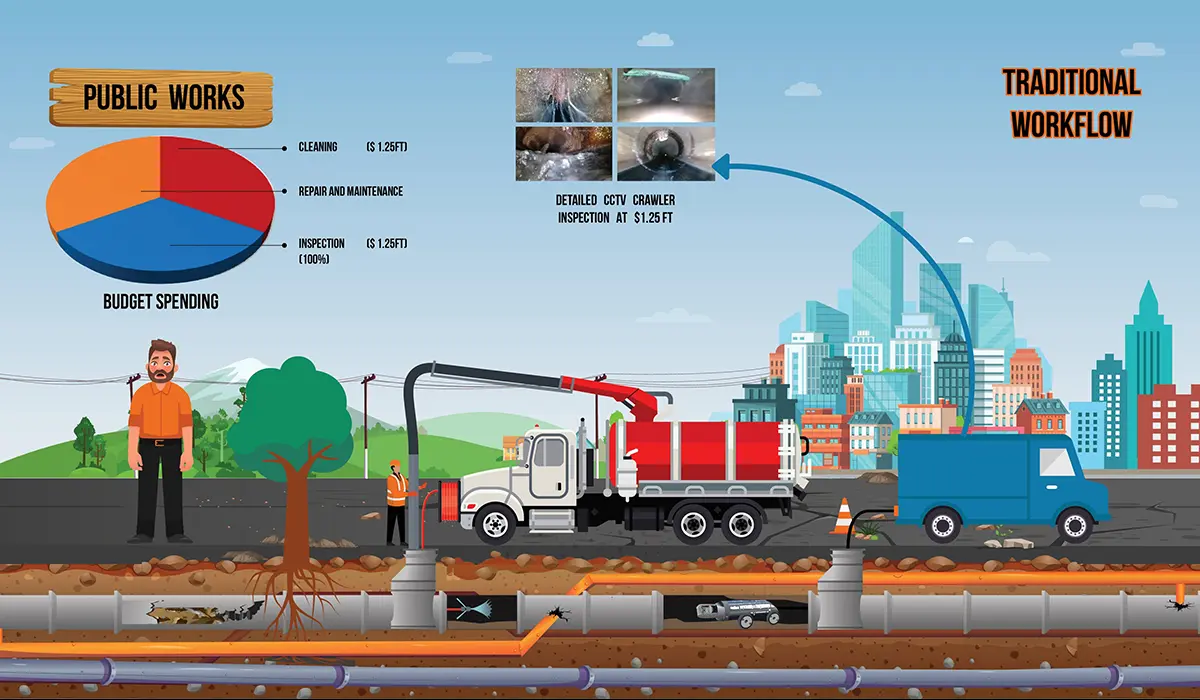
Traditional sewer maintenance often follows a fixed schedule: clean the network, carry out a separate CCTV inspection, and then plan repairs within the remaining budget.
A jetting truck removes deposits and blockages to restore flow and prepare the pipe for inspection.
A separate CCTV crawler inspection records the condition of the pipe and documents defects.
Inspection findings inform the repair plan. Available budget and crew capacity determine how much work can be completed.
Cleaning and inspection are essential, but they also use time, crews and budget. When an entire network is inspected at fixed intervals, regardless of its actual condition, fewer resources may remain to address the defects already identified.
The challenge is turning those findings into completed work. Starting another inspection cycle while known problems remain unresolved can leave teams collecting more information without improving the condition of the network.
With limited time, crews and budget, every maintenance decision matters. Teams need clear information about pipe condition to answer three practical questions.
Identify signs of damage, obstructions and recurring problems to determine which pipes need maintenance or repair.
Determine where a detailed CCTV inspection is needed to understand a potential defect and plan the right intervention.
Use condition information and risk to decide where immediate follow-up is unnecessary, keeping resources available for higher-priority work.
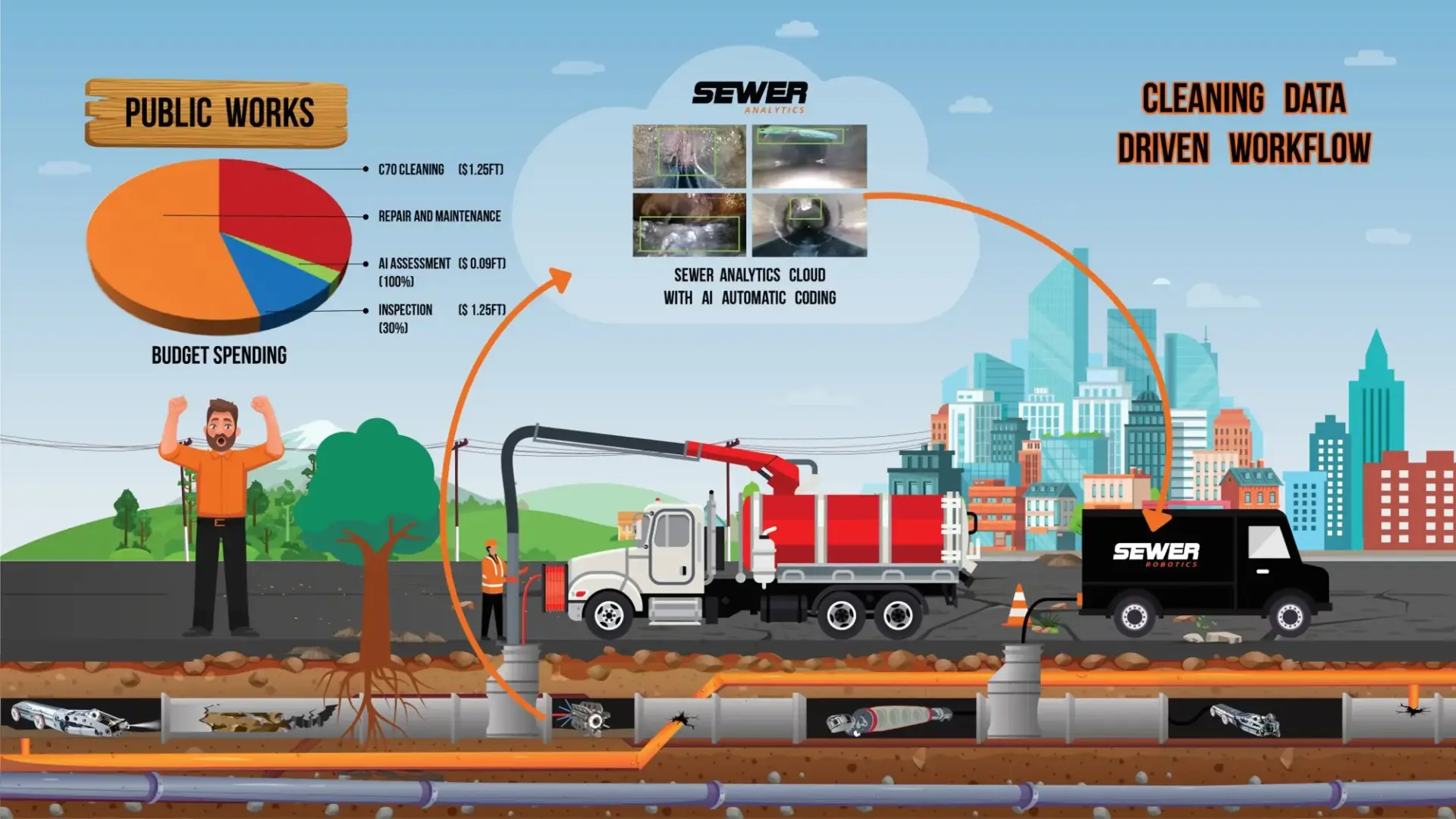
Routine sewer cleaning provides an opportunity to collect valuable information about pipe condition. By recording HD video with the C70 Video Nozzle, teams can review what is happening underground as part of their cleaning operations.
Manual review or AI-supported analysis helps identify where detailed inspection or intervention is needed. This supports targeted follow-up and helps keep more time and budget available for maintenance and repair.
Clean the pipeline and capture HD video in the same pass. Collect valuable information about pipe condition during routine cleaning.
Review cleaning footage manually or use AI-supported analysis to identify and code defects. Choose the approach that suits your workflow.
Use the findings to determine which pipelines need detailed inspection, maintenance or repair. Focus follow-up work where it is needed.
Remove roots, grease, grout, cement and mineral deposits with precisely controlled high-pressure water jets.
Repair local pipe defects with the UVP125 packer and a pre-impregnated liner. UV curing eliminates the need for on-site resin mixing.
Reopen lateral connections after CIPP relining and remove protruding taps. Controlled cutting helps restore clear connections.
Combine a modular crawler with interchangeable, job-specific modules. Carry out different robotic interventions with one system, one truck and one crew.
Avoid unnecessary follow-up inspections and direct more of your available budget towards resolving actual pipeline problems.
Hover your mouse over the photo to discover!
Thank you for your online demonstration request.
Your preferred date and time will soon be reviewed and login to the online meeting shared. We are looking forward to meeting you.
Best regards,
Sewer Robotics
info@sewerrobotics.com
+3174 289475
+1 503 504 8474
Here you will find our most recent news articles
We are present at various international events and even host our own